


















Algorithmic Accountability in Global Mobility: The EU Ai Act and International Health Insurance
- Written by: iPMI Global
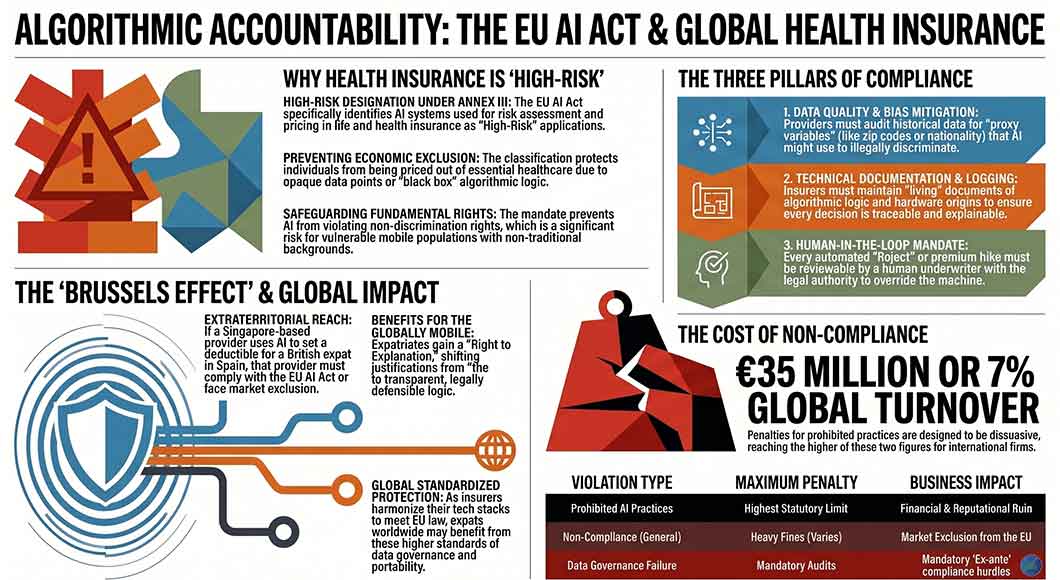
1. Introduction: A New Regulatory Epoch in Actuarial Science
For decades, the International Private Medical Insurance (IPMI) sector has been anchored by the stable, predictable methodologies of traditional actuarial science. However, the aggressive integration of machine learning (ML) and artificial intelligence (AI) into underwriting workflows has created a significant regulatory gap where technological velocity has far outpaced existing governance. The European Union AI Act—the world’s first comprehensive horizontal legal framework—is designed to bridge this divide by reclassifying health insurance pricing and risk assessment as primary areas of regulatory concern.
For the global expatriate community, accountability. As providers increasingly rely on complex automated systems, the EU AI Act ensures that technological progress is balanced against the necessity for fairness and transparency. This transition moves the industry from a reliance on local oversight toward a sophisticated model of global enforcement and extra-territorial reach.
2. The Extraterritorial Reach: The "Brussels Effect" 2.0
The jurisdictional scope of the EU AI Act is a paramount strategic concern for international providers, regardless of their physical headquarters. Much like the GDPR, the Act leverages the "Brussels Effect," establishing EU regulatory standards as a de facto global standard for the insurance industry. The Act’s reach is explicitly extra-territorial: it applies to any "provider" or "deployer" of AI systems if the output produced by that system is utilized within the Union, effectively governing the use of AI outputs rather than just the location of the data processing.
Scenario: A Singapore-based IPMI provider utilizes an advanced AI engine to determine the deductible for a British expatriate currently residing in Spain.
Mechanics of Jurisdiction: Because the AI’s output—the specific premium or deductible—directly affects an individual located within the EU, the Singaporean firm falls under the jurisdiction of the EU AI Act.
Strategic Risk: The provider must adhere to all high-risk obligations mandated by the Act. Failure to adapt constitutes a major strategic risk of "market exclusion," where firms may be legally barred from the European market or found unable to serve the globally mobile workforce.
This jurisdictional reality ensures that the classification of insurance activities as "high-risk" has immediate, unavoidable global implications for any firm with a multi-national footprint.
3. The "High-Risk" Designation: Why Health Insurance is Targeted
Under Annex III of the EU AI Act, AI systems used for risk assessment and pricing in life and health insurance are officially designated as "High-Risk." This classification reflects a fundamental regulatory shift: health insurance pricing is no longer viewed as a private commercial activity, but as a critical application of AI with profound societal consequences and potential for discrimination.
|
Primary Factor |
Regulatory Concern |
Societal Impact |
|
Financial Impact |
AI decisions can lead to "economic exclusion." |
Individuals may be priced out of essential healthcare based on opaque or automated data points. |
|
Fundamental Rights |
Risk of violating rights to non-discrimination and health access. |
Biased AI can unfairly restrict medical coverage for vulnerable mobile populations. |
This high-risk designation triggers a rigorous compliance lifecycle. Providers must navigate "Ex-ante" requirements—obligations that must be satisfied prior to deployment—and maintain "Ex-post" compliance throughout the system's operational lifespan. By mandating that these requirements are integrated into the earliest product development stages, the Act forces a total reassessment of operational workflows.
4. Critical Compliance Pillars for IPMI Providers
The shift to a high-risk regulatory environment imposes an extensive operational burden, forcing a strategic pivot from data quantity to data quality and transparency. Three pillars define this transition:
Data Quality and Bias Mitigation: The Act mandates that training, validation, and testing datasets must be relevant, representative, and error-free. Insurers are now required to audit historical data for "proxy variables"—such as zip codes or previous nationalities—which AI might inadvertently use as a basis for illegal discrimination against ethnic or social groups.
Technical Documentation and Traceability: Providers must maintain "Living" Technical Documentation. This includes comprehensive design specifications, algorithmic logic, and hardware resource mapping. Automatic logging is required to ensure the "traceability" of every decision, a critical requirement for when a policyholder disputes a premium increase or coverage denial.
The "Human-in-the-Loop" Mandate: High-risk AI systems must be designed for effective oversight by natural persons. This disrupts fully automated "Reject" workflows, requiring that any denial of health insurance be reviewable by a human underwriter with the explicit authority to override the machine’s decision.
From a strategist's perspective, these pillars transform the internal culture of an insurance firm from "AI-first" to "Audit-ready." This transition is not merely a legal hurdle; it is a competitive moat that reduces future legal liability and enhances market reputation in an era of heightened scrutiny.
5. Impact on the Globally Mobile Workforce
Expatriates and digital nomads often possess "thin files"—a lack of traditional medical or credit history in new jurisdictions. Historically, "black box" algorithms have flagged these individuals as high-risk simply due to a lack of representative data. The EU AI Act provides essential safeguards for these vulnerable populations by linking the "Right to Explanation" to data quality mandates.
The benefits for the mobile workforce include:
The Right to Explanation: Policyholders now have the legal standing to demand the specific rationale behind a premium setting. This protects individuals with non-traditional data histories from being automatically rejected by algorithms that lack representative datasets.
Standardized Protection: As global insurers harmonize their technology stacks to meet EU requirements, these high standards will likely become the global baseline, benefiting expats even when they reside outside the Union.
Portability and Continuity: Standardized data governance facilitates more portable health risk profiles. When data is handled via transparent, harmonized protocols, it becomes easier for individuals to maintain continuity of coverage as they move between international markets.
6. The Cost of Non-Compliance: Financial and Reputational Risk
The penalty framework of the EU AI Act is intentionally "dissuasive," designed to ensure that algorithmic accountability is treated as a core business priority.
Financial Penalty Structure for High-Risk & Prohibited Practices
Prohibited AI Practices: Engaging in prohibited activities, such as biometric categorization for health profiling, can result in fines of up to €35 million or 7% of total global annual turnover, whichever is higher.
For international firms, the stakes are more than just financial. In a sector predicated on trust and security, a finding of systemic algorithmic bias can cause irreparable reputational damage. Conversely, firms that lead with compliance can frame their "Audit-ready" status as a mark of reliability, gaining a competitive advantage among multinational corporations and high-net-worth nomads.
7. Conclusion: From "AI-First" to "Trust-First" Engineering
iPMI Global CEO Christopher Knight concludes, "The EU AI Act represents a fundamental restructuring of the "Social Contract" between insurers and the insured. By mandating transparency, human oversight, and rigorous data standards, the Act ensures that the move toward machine learning does not erode the fundamental rights of the global workforce.
The path forward for the international health insurance industry requires a total transition from "AI-first" to "Trust-first" engineering. While the costs of compliance and the necessary operational overhauls are high, the move toward a fairer, more transparent system is essential for the long-term sustainability of the global mobility sector. The future of the industry belongs to those who view accountability not as a burden, but as the foundation of a trust-first industry."