
Market Analysis: The Critical Value Proposition of Western-Standard Hospitals for the Expatriate Community
- Written by: iPMI Global
Introduction: Defining the Expatriate Healthcare Imperative
For expatriates undertaking international assignments, access to reliable, high-quality healthcare is not a peripheral benefit but a foundational requirement for success. It is a critical factor that directly influences personal well-being, family security, and the overall viability of a professional relocation. Without confidence in the available medical infrastructure, both the employee and their employer face significant operational and personal risks.
Western-standard international hospitals address this need by functioning as a critical "ecosystem of familiarity and trust." These institutions are specifically designed to bridge the medical, linguistic, and cultural gaps that expatriates encounter in foreign healthcare systems, offering a lifeline in often complex and uncertain environments. This analysis will examine the specific market needs these institutions fulfil and the core value drivers that make them an indispensable asset for the global expatriate community.
Core Value Driver 1: Mitigating Clinical Risk through Clear Communication
In any medical setting, clear communication between patient and provider is paramount for accurate diagnosis and effective treatment. For expatriates navigating foreign healthcare systems, however, miscommunication due to language and cultural barriers represents one of the most significant and dangerous points of failure. International hospitals are structured to eliminate this fundamental risk.
This is accomplished through several key operational pillars:
- Multilingual Expertise: These facilities prioritize the recruitment of medical professionals who are fluent in English and other major international languages. This ensures that the subtle but crucial details of a patient's symptoms, medical history, and concerns are conveyed accurately, forming the basis for a correct diagnosis and a clearly understood treatment plan.
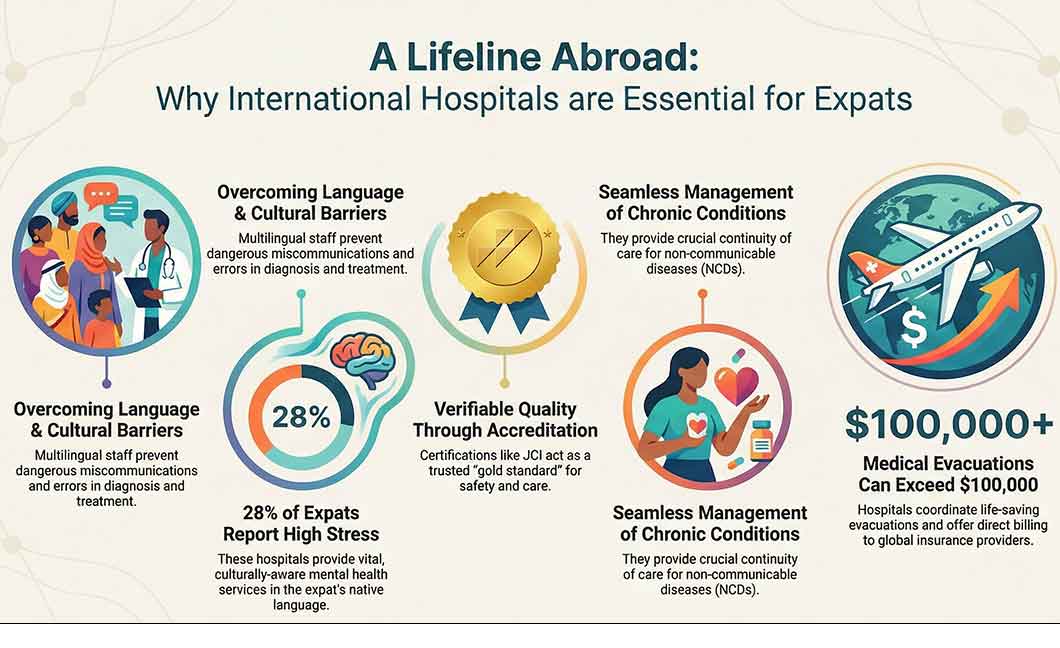
- Data-Driven Need: The market demand for this service is clear. In countries where expatriates report high levels of concern about local healthcare quality, one survey found that 12% of respondents were specifically worried about the challenge of arranging treatment in a foreign language, a tangible barrier to care that increases corporate liability.
- Cultural Competency: Beyond simple translation, staff are trained in the cultural nuances of patient care. This training is critical for moving beyond translation to true understanding, preventing misinterpretations of patient stoicism or family dynamics that could otherwise lead to diagnostic errors or non-compliance with treatment plans.
By neutralizing the risk of miscommunication, these hospitals establish a foundation of clinical safety, which paves the way for managing more complex, long-term health challenges.
Core Value Driver 2: Ensuring Continuity for Chronic Condition Management
Expatriate assignments frequently span multiple years, necessitating the consistent and seamless management of chronic or non-communicable diseases (NCDs). This presents a significant challenge to the corporate duty of care, as local public health systems are often not equipped to provide this level of continuity. International hospitals fill this gap by providing a stable and predictable platform for long-term care.
They deliver this continuity through specific, targeted mechanisms:
- Standardized Medical Records: Utilizing Electronic Medical Records (EMRs) that are compatible with Western formats, these hospitals ensure that a patient's complete medical history is always accessible, legible, and easily transferable. This eliminates dangerous information gaps and supports coherent, long-term treatment strategies.
- Pharmaceutical Consistency: These facilities de-risk the corporate duty of care by guaranteeing access to mission-critical medications. International hospital pharmacies possess the logistical and regulatory expertise to navigate complex international pharmaceutical supply chains, ensuring uninterrupted access to vital brand-name prescriptions or their precise equivalents.
- Market Scale: The prevalence of NCDs highlights the severity of this issue. Research from major expatriate hubs reveals that such conditions are a common health problem, with rates reported as high as 95.7% in some key destinations. International hospitals provide the specialized, continuous care this large market segment requires.
Managing the predictable needs of chronic care is essential, but these institutions also prove their worth during unpredictable and acute medical emergencies by providing a crucial financial and logistical buffer.
Core Value Driver 3: Providing a Financial and Logistical Safety Net
Unforeseen medical crises can impose catastrophic financial and logistical burdens on expatriates, particularly in systems that are not integrated with global insurance norms. International hospitals are strategically structured to absorb this complexity, functioning as a vital safety net during a patient's most vulnerable moments.
This safety net has two primary functions:
- Eliminating Financial Volatility and Patient Burden Local hospitals, including some private facilities, often demand large, upfront cash payments before treatment can begin. In contrast, Western-standard international hospitals have established direct-billing relationships with major global insurance providers. This core capability eliminates the immediate financial burden on the patient and their family, allowing them to focus on recovery rather than on navigating complex payment logistics during a stressful emergency.
- Emergency Medevac Coordination In life-threatening situations where highly specialized care is unavailable locally, a Medical Evacuation (Medevac) becomes necessary. International hospitals serve as the indispensable coordinating hub for this process. They manage the overwhelming logistics of a medical transfer, which can cost anywhere from $10,000 to $100,000, for families already in crisis. By handling the clinical assessments, transfer protocols, and communication with aviation services, the hospital provides an organized response to a potentially chaotic and financially devastating event.
While the hospital provides a critical safety net for acute physical trauma, it plays an equally vital role in managing the chronic emotional trauma that can define the expatriate experience.
Core Value Driver 4: Addressing the Expatriate Mental Health Gap
The process of relocating to a new country exposes individuals and their families to a unique combination of psychological stressors, including culture shock, social isolation, and intense job pressure. This phenomenon, sometimes referred to as "Expat Syndrome," creates a significant and frequently unmet demand for accessible mental health support within the expatriate community.
International hospitals offer a unique value proposition by directly addressing the primary barriers that prevent expatriates from seeking help:
- Accessible, Language-Appropriate Care: These facilities offer counselling and psychological support from providers fluent in the expat's native language. This removes the primary obstacle to effective therapy, where nuance and clarity are essential.
- Culturally Aware Support: The mental health professionals at these hospitals typically possess a deep understanding of the specific challenges associated with living and working abroad, allowing them to provide relevant, empathetic support.
- Integrated Care in a Trusted Setting: By integrating mental health services into a general clinical setting that expatriates already trust for their physical healthcare, these hospitals help de-stigmatize treatment and significantly increase the likelihood that an individual will seek necessary support.
- Quantifying the Need: The market gap for these services is substantial. A 2021 well-being survey revealed that a concerning 28% of expats rated their stress levels at the highest possible tier. This represents a direct threat to employee productivity and assignment success, underscoring the need for trusted and accessible care settings.
The trust that expatriates place in these institutions for both physical and mental healthcare is not accidental; it is built on a foundation of verifiable quality and safety.
Core Value Driver 5: Delivering Verifiable Trust and Quality Assurance
When arriving in a new country, expatriates and their employers lack the local knowledge required to vet the quality of medical providers. This information asymmetry creates uncertainty and risk. International hospitals overcome this challenge by voluntarily submitting to rigorous third-party accreditation, providing a clear and reliable proxy for quality and safety.
This trust is built and communicated through two key elements:
- Leveraging Third-Party Accreditation as a Verifiable Proxy for Quality Accreditation from Joint Commission International (JCI), a US-based organization, is widely recognized as the global gold standard. The JCI seal signifies that a hospital has met hundreds of measurable criteria related to patient safety, clinical quality, and ethical practices. For an employer, this serves as a critical tool for satisfying corporate governance and liability requirements related to their duty of care.
- Impact on Patient Behaviour The presence of such accreditation directly influences whether an expatriate will seek care locally. This "medical flight risk," which represents up to 65% of the expatriate population in some regions, constitutes a significant operational and talent retention liability for employers—a liability that accredited hospitals directly neutralize by providing confidence that high-quality care is available in-country.
Together, these distinct value drivers combine to form a comprehensive platform for mitigating the multifaceted risks associated with living and working abroad.
Conclusion: The International Hospital as an Essential Risk Mitigation Platform
The collective value proposition of a Western-standard international hospital can be synthesized into a single, overarching function: it is a comprehensive risk mitigation strategy for expatriates and their employers. These institutions systematically address the primary points of failure and anxiety that define the healthcare experience in a foreign country, creating an environment of safety, predictability, and trust.
This strategy is executed across three fundamental categories of risk:
- Mitigating Clinical Risk: Achieved through adherence to the highest international standards of care, the elimination of communication barriers, and verifiable quality assurance via accreditation.
- Mitigating Financial Risk: Delivered through established direct-billing systems and expert coordination with global insurers, which prevent catastrophic out-of-pocket expenses during medical emergencies.
- Mitigating Emotional Risk: Provided through culturally and linguistically appropriate support for both physical and mental health challenges, reducing the stress and isolation inherent in the expatriate journey.
Ultimately, these institutions are not merely healthcare providers; they are indispensable enablers of global mobility, underwriting the human capital that drives international business.


